Sustainable Benefits to New Zealand
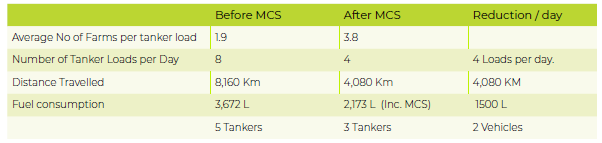
The mobile concentration system (MCS) reduces impact on both our watersheds, and our roading infrastructure by reducing tanker movements by up to 50%, on the MCS administered routes.
The membrane system removes water from the milk at the farm, prior to transport, this water is of very high quality. Water can then be returned to the farm, and can be used for in process cleaning, or irrigation. Reducing farm water use, as well as reducing transport costs (having transport volume), and processing cost at the factory (reduced energy cost for water removal by filtration or evaporation).
While the MCS requires energy and time to run the membrane plant, this is offset by reduced transport and Fleet operational costs. The MCS integrated cooling and energy recovery system has the potential to open up the farm milk collection window, optimise milk collection scheduling, reduce on farm chilling cost and improve milk quality. An overall lower milk transport temperature and storage temperature has the proven potential to improve manufacturing yield and product quality.
All of these financial benefits lead to an overall reduced carbon footprint and for a more sustainable milk collection operation for the global dairy industry. Using real world milk collection data from the Waikato region, Pacific Process have prepared detailed cost models that show a reduction from 5 milk tankers to 3 for the milk collection and a savings in excess of $600,000 per year for each large MCS unit in operation.
While tanker movements are reduced, there is upskilling of operational staff, who will now not only be driving, but also be responsible for management and operation of a $1.5 million dollar mobile membrane plant.
This solution meets many of New Zealand’s key long term objectives, with a reduction in the use of fossil fuels, a reduction or slowdown in the number of trucks on New Zealand roads and increased productivity. As we are aware, 93% of all freight movements in New Zealand are on road and the process of collecting milk in
New Zealand, and is a significant part of that at 21 billion litres annually. This means the scope for change is significant, and even if the reduction is only 35% in truck movements, it still equates to an estimated 26,000 tons of carbon annually that will not enter the atmosphere.
The Mobile Concentration Plants not only provide potable water as a by-product, for use on farm or industry, but can also process other water streams for provision of water for humanitarian purposes during drought or water contamination events.
For applications such as spray drying, the removal of water leads to reduced processing costs. Collecting milk concentrate, reduces the capacity requirement for milk silos, reducing processing capex. Every 80kg of water removed via the MCS will save 1KW of energy at the Spray Drier evaporator equating to roughly $40 energy savings for a tanker load of 30,000 Litres of milk concentrate.
As labour cost increase, along with Road User Charges, Fuel cost and Carbon Taxes, the MCS system benefits will continue to accrue.